No to the Firing Range.

Seven thousand five hundred hectares, entirely private farmland, with direct impact on Alter do Chão, Crato, Fronteira, Monforte and neighbouring municipalities, over montado and the REN high-pressure gas pipeline, within the impact radius of the Natura 2000 network and the Monforte SPA, and in the same municipality as equestrian heritage. Announced with no studies. Decided before the public consultation.

Public admission · 11 March 2026

The impact studies and others (…) are those required by law and they will be carried out.
Nuno Melo, Minister of National Defence Press conference, Lisbon, 11 March 2026. Statement published on portugal.gov.pt on 12 March, 10:26.

The responsible member of the Government acknowledges, in an official statement, that the legally mandatory studies had not yet been carried out at the moment the project's location was made public.

Assinaturas 2,446
Municipality population 3,180
Parliamentary groups 4 initiatives

Who we are

The “No to the Firing Range” platform is a civic platform of the Alto Alentejo. It brings together farmers, business owners, associations, citizens and professionals in common opposition to the military firing range announced by the Government on 11 March 2026.

We defend the integrity of the montado (cork and holm oak woodland), the Natura 2000 network (Cabeção SAC PTCON0029 and Monforte SPA PTZPE0051), the Alter do Chão Important Bird Area (IBA PT017) and the Alter Real Royal Stud (Coudelaria de Alter Real), founded in 1748, a central institution of Portuguese Equestrian Art, inscribed by UNESCO on the Representative List of the Intangible Cultural Heritage of Humanity on 3 December 2024. We defend the livelihoods of more than fifty family farms and of the 58 to 81 distinct farmers directly affected by the planned area.

We demand that the studies required by law be carried out before the decision and not after it. We are not against national defence. We are against this siting decision, taken with no prior technical assessment and in clear contradiction with the State's own acts.

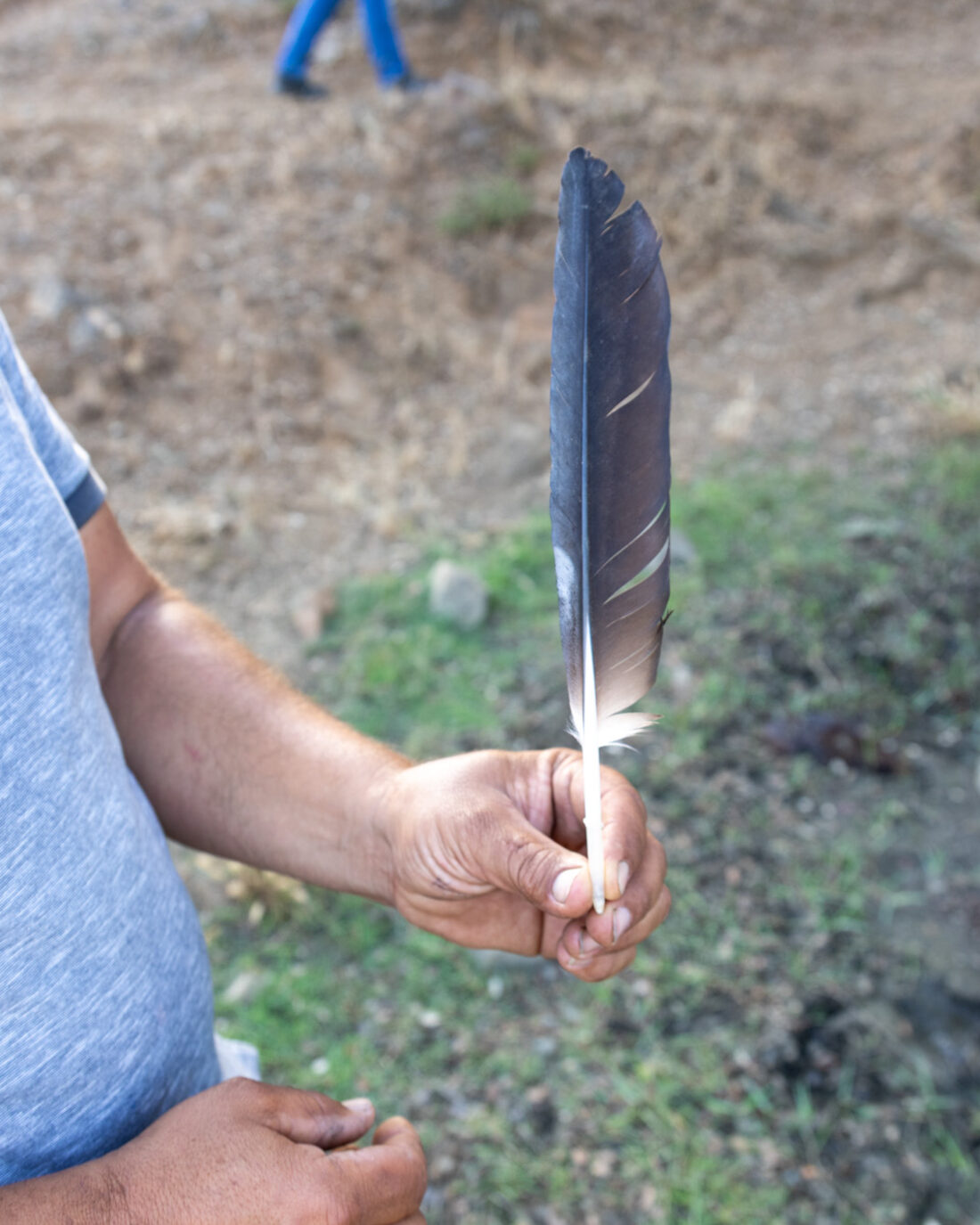
A farmer's hand holding a bird of prey feather, in the field

The case in three moments

What happened, why it is illegitimate, and what alternative exists.

The institutional summary of the case, with the three moments that structure the platform's position. The full sequence is substantiated in the arguments dossier.

What happened

On 11 March 2026, the Minister of Defence announced that the Air Force firing range would leave Alcochete (to make way for the new airport) and move to Alter do Chão. He announced it with no prior studies, no environmental impact assessment, no public consultation, without disclosing the cost, and without mentioning that a high-pressure gas pipeline runs through the middle of the area.

Why it is illegitimate

The person who announced it admitted there were no studies. The same Government had approved, 28 days before the announcement, the decree protecting the chosen area. It did not consult REN about the pipeline, did not consult the population, and published no study comparing Alter with other locations. This constitutes a breach of procedure, of the constitutional principles of participation, and of the binding European framework of prior assessment.

What alternative exists

The Air Force has identified Mértola and Serpa as the best technical option since 2007. NATO has offered Bardenas Reales, in Spain, since 1982, with 80 percent of its capacity available, at between €5 and €20 million a year. The Government is obliged to assess these alternatives in an Environmental Impact Assessment. First the study. Then the decision.

The case in figures

Twelve figures that underpin the opposition.

Data consolidated from official sources and civic records. Each figure points to a verifiable documentary source. Full list, with sources, on a dedicated page.

7,500
Hectares planned for the firing range, spanning several municipalities of the Alto Alentejo (Alter do Chão, Monforte, Crato and Fronteira).
100%
Of the planned perimeter is private farmland. The State has public land in the region that it did not use.
329-375
Agricultural plots with an active CAP application in 2025 within the planned perimeter, according to IFAP cross-referencing.
11.8 km
Of REN gas pipeline at 85 bar cross the perimeter. Rerouting: €85 to 215 million and 5 to 8 years.
€298-608M
Independent estimate of the total cost. The Minister publicly refused to present any official figure.
28
Days between Decree-Law 35/2026 (protecting the Cabeção SAC) and the announcement of the firing range in the same area.
200
Military personnel and their families to be relocated to the municipality, according to the official statement. The municipality has 3,180 inhabitants.
2,446
Signatures of citizens from across the country on Public Petition PT130367 against the installation of the firing range.
Last updated on 22 July 2026. Reference document: the full case documentation (June 2026).

Case status

Where we stand today.

Public Petition PT130367 has gathered 2,446 signatures and crossed the legal threshold of one thousand that requires publication in the Journal of the Assembly of the Republic and a hearing of the petitioners in committee. Four parliamentary groups have tabled scrutiny initiatives: Bloco de Esquerda on 18 March, Partido Socialista on 18 March and 25 April, Partido Comunista Português on 30 March and 2 April, Chega on 29 April. The Mayor publicly reversed his initial position and, on 1 May, declared he was awaiting the studies.

The Air Force's preliminary studies have not yet been published. The project's official cartography is not public, and the maps circulating among the farmers are, reportedly, the only material the Municipality has had access to. The Alter Real Royal Stud has issued no public position on the case. The Portuguese Environment Agency has no record of an open procedure on the participa.pt portal.

On 9 June 2026 a documentary update was consolidated (Chapter X, sixteen new vectors), with cross-referenced data from IFAP, REN, the Court of Justice of the European Union and the technical contribution of the petition's first signatory.

Full case timeline →

Frequently asked questions

The four most common questions.

Answers to the most common questions about the case. The full list includes rebuttals to the typical arguments raised in favour of the project.

  • Are the arguments really environmental, or is it just opposition from people who don't want the project on their doorstep?

    The accusation of parochial opposition, or of defending purely local interests, ignores a verifiable fact: there are concrete technical alternatives that were never assessed. Bardenas Reales, in Spain, has been open to NATO allies since 1982, with 80 percent of its capacity available, at €5 to 20 million a year. Mértola was the Air Force's technical choice from 2007. None of these alternatives was publicly reassessed before the announcement. The territory of Alter do Chão has the same value as any other territory in the country; the difference is that no one asked its people whether they accepted the sacrifice.

  • Isn't national defence at stake?

    No. What is at stake is the way this decision was made. Those who take national defence seriously do planning, studies and assessment of alternatives, not announcements at a press conference before any technical assessment. The Portuguese Air Force itself identified Mértola as the best technical option in 2007. Another location was chosen with no publicly disclosed criterion. Allowing national defence to be administered without criteria harms defence itself.

  • Can't the State pay fair compensation to the affected farmers?

    The monetary compensation provided for in the Expropriation Code pays for the land, not for the farming activity built on top of it. It does not buy a new profession for someone who loses theirs. It is not fifty properties at stake: it is fifty active farms, with jobs, value chains, generations of knowledge and montados with centuries-old cork oaks protected by national law. Paying for the land does not restore that. Moreover, the expropriation of these farms contradicts the mayor's public assurance that the area would be State land.

  • Is there really a gas pipeline in the middle of the area? Wouldn't it be easy to go around it?

    The Campo Maior–Leiria gas pipeline runs 11.8 kilometres inside the planned area, at an operating pressure of 85 bar. It is Portugal's main natural gas entry point. The Regulation of the National Gas Transmission Network (Order 806-C/2022, DGEG) imposes an obligation to contact REN before any project nearby, a minimum distance of 75 metres and prior authorisation for any work. Rerouting it costs between €85 and 215 million and takes between five and eight years. Firing live rounds over a pipeline at 85 bar without REN's authorisation would be, strictly speaking, illegal.

See all questions →

Follow